Services
Full vehicle wraps in Charlotte
A full wrap is a defined boundary, not a superlative. It means printed cast film across every exterior painted panel that shows with the vehicle closed up, and it stops there: jambs, roof and the areas below the bumper line are separate decisions with separate costs, settled before the order is written rather than assumed into it. Most of what decides whether that film stays down happens before any of it is printed.
- From
- Quote on request
Specification
- Coverage
- Every exterior painted panel visible with the vehicle closed up. Door jambs, roof, below-bumper areas and textured unpainted plastic are quoted separately or excluded.
- Materials
- Cast PVC print film at 2 mil with air-release, repositionable adhesive, finished with a cast overlaminate.
- Expected life
- Confirmed at quote
- Warranty
- Confirmed at quote
What "full" covers, and the four places it stops
Full coverage means printed film across every exterior panel visible with the doors, hood and rear closed: both sides, the hood, the rear, the pillars between the glass, and painted bumpers. Four areas sit outside that by default and each is quoted as an addition rather than folded in silently. Door jambs and the shut faces behind them, which are only visible with the vehicle open. The roof, which almost nobody reads at ground level and which adds material across the largest single panel plus platform access to every booking. The band below the bumper line and behind the wheel arches, where road blast takes film off first. And any textured or unpainted plastic, which is not a pricing question at all, because film will not stay on it. We write all four onto the order marked in or out, because "full" is the word in this trade that most often means one thing to a shop and another to the buyer.
Cast film, air-release adhesive, and what calendered film does instead
A full wrap is built from cast PVC film, nominally 2 mil, printed and then overlaminated. Cast film is made by casting liquid PVC onto a moving web and letting it set without tension, so it carries no memory: worked into a recess or around a mirror stalk, it stays where it was put. Calendered film is squeezed out of a mass under pressure and holds that stress in the sheet, which is why over months it shrinks back, pulls out of channels and lifts along cut edges. Calendered material has a real place on flat panel and short campaigns and no place on full coverage over a curved body. The adhesive matters as much as the face film: wrap-grade adhesive is laid in a channel pattern so trapped air has somewhere to go, and stays repositionable long enough for a large panel to be placed twice. The cast overlaminate above the print is what takes the UV, the wash brushes and the grit.
Prep is the part of the job nobody sees
Film bonds to what is on the panel, not to the panel. A vehicle arriving off a route carries road film, diesel haze, wax, silicone from dressings and traffic grit packed into every seam, and film laid over any of that is bonded to a layer which is itself letting go. Prep runs wash, degrease, a clay or solvent pass, then a final alcohol wipe panel by panel immediately before film touches it. Hardware comes off rather than being cut around, and edges and recesses take an adhesion promoter sparingly, because promoter is also what makes a removal expensive later. Paint condition sets the hard limit. Lifting clear coat, primer showing through, corrosion blooming at a seam, and fresh paint that has not finished gassing off will all come away with the film, and the painter's data sheet decides how long a repaint needs before it is ready, not us. We inspect for all of it and price the job afterward, so a disqualifying panel is found at the door rather than at handover.
The sequence, and why the vehicle stays for it
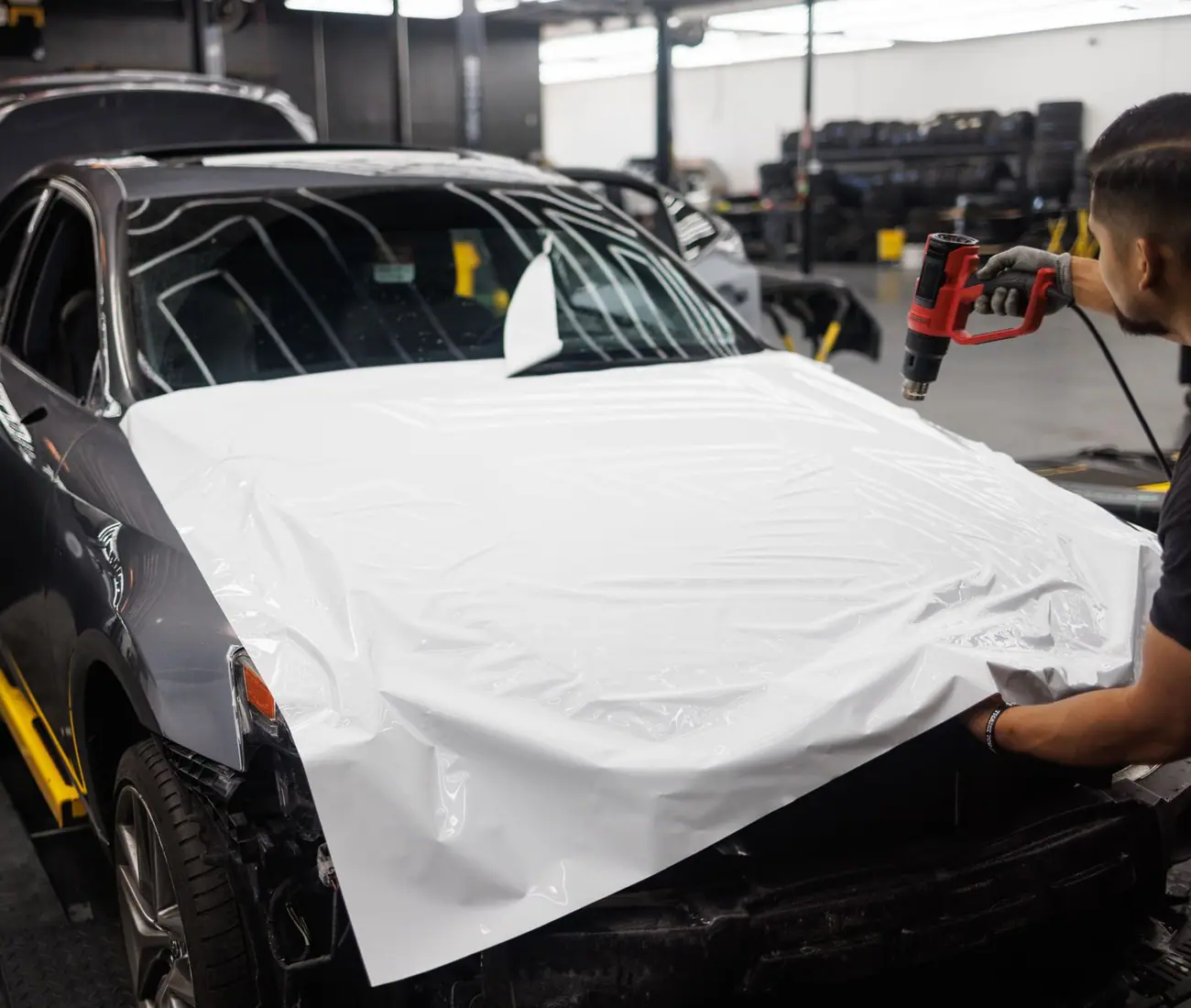
Full coverage is a sequence and the vehicle has to be present for most of it: measurement against a verified template, print, laminate, cut, install, post-heat, then an inspection with every door and panel worked through its travel. Post-heating is the step buyers never see and the one that decides whether recessed film stays down, everywhere the film has been stretched into a channel is brought up to temperature and held there to reset it, well past anything a vehicle reaches parked in July. The work also needs a bay rather than a yard, because cold panels do not take adhesive and airborne dust ends up under the sheet. Adhesive keeps building bond for the first days afterward, which is why the vehicle does not go into a wash or a pressure bay on the way out. How many days a given body style occupies is a vehicle question, and it is answered on the vehicle pages rather than here.
Vehicles we apply this to
Full Wrap questions
Are the door jambs included in a full wrap?
- Not by default. Jamb work puts film on faces that are only visible with the vehicle open, and it adds bay time at every opening. It earns its cost on a vehicle whose doors stand open in front of customers all day, and it is hard to justify on a unit that spends its working life at a loading dock. Either way it appears on the order as its own line, marked in or out.
Does full coverage include the roof?
- Only where it is specified. A roof is the largest single panel on most commercial bodies, it needs platform access, and at street level nobody reads it. Where it earns its place is a vehicle parked under offices or in a deck, or a fleet photographed from above for its own marketing. We quote it separately so the choice is visible instead of buried in a total.
Can film go over a repainted or damaged panel?
- Sound factory paint is the surface film is designed for. A repaint can be fine once it has fully cured. A panel with lifting clear coat, primer showing or corrosion at a seam is not, because adhesive pulls at whatever is already letting go and the damage surfaces at removal. We will decline a panel rather than cover it and hand the problem back later.
What is involved in taking a full wrap off?
- Controlled heat, a shallow pull angle, and adhesive remover on whatever stays behind. Off sound paint the panel comes back as it was found. What makes a removal slow is heavy use of adhesion promoter, film left on well past its service life until it has gone brittle, and any panel that was already failing when the film went on. We book removals as their own job with their own hours rather than tacking them onto the end of something else.